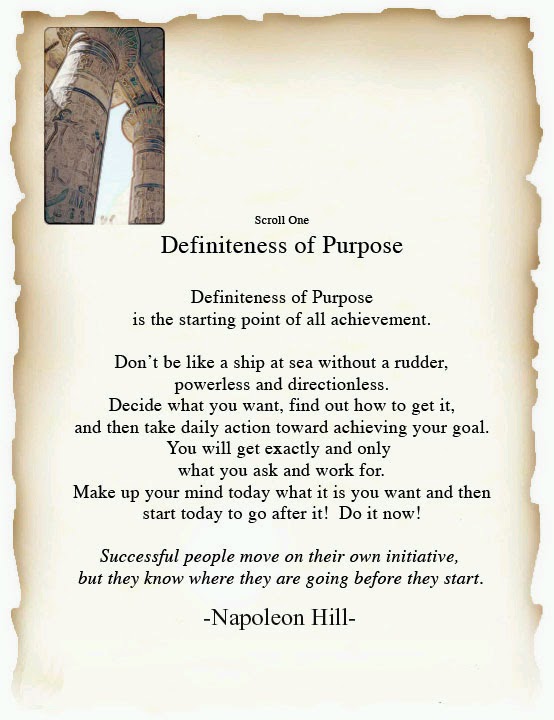
Napoleon Hill was an American author who was one of the earliest producers of the modern genre of personal-success literature. He is widely considered to be one of the great writers on success and his most famous work, Think and Grow Rich, is one of the best-selling books of all time. Hill's works examined the power of personal beliefs, and the role they play in personal success. "What the mind of man can conceive and believe, it can achieve" is one of Hill's hallmark expressions. How achievement actually occurs, and a formula for it that puts success in reach for the average person, were the focal points of Hill's books and teachings.
Hill considered the turning point in his life to have occurred with his assignment, as part of a series of articles about famous and successful men, to interview the industrialist Andrew Carnegie. At the time, Carnegie was one of the most powerful men in the world. Hill discovered that Carnegie believed that the process of success could be outlined in a simple formula that anyone would be able to understand and achieve. Impressed with Hill, Carnegie asked him if he was up to the task of putting together this information, to interview or analyze over 500 successful men and women, many of them millionaires, in order to discover and publish this formula for success.
This video link explains Hills exploration into personal and professional development through his meetings with Andrew Carnegie. Enjoy the wisdom shared by Napoleon Hill!
Get Coached Today!
Leadership Tools - Building Confidence in Others
Do you ever wonder how great leaders create self-assured teams?
Think about watching a sports match between two teams, where one team is more confident than the other. The members of the more confident team know that they have a good chance of winning. As a result, everyone on the team makes good decisions, and the players work together seamlessly. Meanwhile, the other team's confidence is shaky. Players doubt their abilities, they hesitate, and they don't commit fully to any particular course of action. When this happens, it's likely that the more confident team will win.
The same principles apply in the workplace - when you have people on your team who have low self-confidence, this can hold them back from reaching their full potential.
This is why it's important that we do what we can to boost the confidence of those around us, especially if we're leading a team.
Recognizing Low Self-Confidence
People who lack self-confidence rarely thrive. They see more risks than opportunities, they don't perform particularly well in new situations, and they often have low self-esteem. What's more, they rarely trust their own judgment, and they may see any successes that they do achieve as resulting from luck, rather than from their own efforts.
By contrast, people who have high self-confidence are more productive and more effective, and can raise the morale of the entire group. They're also more comfortable taking risks, which can have benefits for their own careers, as well as for their teams.
Confidence can make or break people's ability to achieve their life goals. So how can you help boost the self-confidence of the people around you?
Help Them Develop Knowledge and Skills
Chances are that there are several skills you rely on to do your job well. When you use these skills successfully, what happens? You feel confident! These are the skills that you've worked on over the years, and you're comfortable that you can use them to accomplish the task at hand.
The same is true for the people on your team. The stronger their skills are, the more confident they're going to feel.
So a good way to increase the self-confidence of people in your team is by encouraging learning, and by providing plenty of opportunities for additional training. The more knowledge and skills that people have to do their job, the more confident they're going to feel, especially when they approach challenging projects.
Set Clear Goals and Help Them Achieve Them
Many people get confidence from completing tasks and projects successfully. But that confidence only comes if people know what it is that they're supposed to do.
This is why it is so important to set clear goals for every member of your team. Goals define success, and give people an objective to shoot for. Without them, they're working aimlessly.
So make sure that the people on your team know what goals they're supposed to be working toward, and help them to achieve these goals. Then, when they succeed, celebrate their achievements!
Help Them Identify "Triggers"
All of us experience fluctuations in our confidence - some tasks or situations lift us up, while others can cause our confidence to drop.
If you work with someone who has low self-confidence, help him to identify his "trigger situations." By knowing what causes his confidence to waver, he can work to build the knowledge and skills he needs to feel more confident.
To do this, grab a piece of paper and a pen, and sit down with this person. Divide the page into two columns. On one side, ask him to list the situations that make him feel confident. This could be anything, from writing the corporate blog to helping shape your department's budget. Anything that makes him feel happy and confident should go on this list. Then, next to each task, have him write down why he's confident in these situations. What knowledge or skill is he using that makes him feel good?
Next, ask him to list the situations that don't make him feel confident. This could include giving presentations, expressing his opinion in meetings, or writing a report. Why doesn't he feel confident in these situations? What new knowledge and skills would help him feel better in each scenario?
It can be an eye-opening experience to identify these triggers. But, once he can see which skills he could improve on, he'll be more motivated to face his fears.
You could also use role playing with him. This is a useful technique that allows him to practice succeeding in low-confidence scenarios. To do this, you'll need to talk to this person about his self-confidence, which may be something that he instinctively tries to avoid. You're much more likely to be successful if you have this conversation as part of a coaching or mentoring relationship.
Encourage Autonomy
If you want your team to tackle tasks with confidence, it's important that you allow them the autonomy to make their own decisions. When your people have the power to decide what needs to be done, they start to take ownership of their work. It truly becomes their responsibility, and when they succeed, their confidence can soar.
Whenever you can, delegate tasks and give your people the power to make their own decisions. Be aware, however, that people who have low self-confidence may resist this at first: after all, they may doubt that they'll make the right decisions. To fight these doubts, encourage them to take on small, achievable projects. Then, if they rely on you too much for help or guidance, encourage them to be more independent This will push them to make their own decisions, instead of running to you for help or advice.
Celebrate Success
It's important that all of us celebrate the success we've achieved, because recognition of success builds self-confidence. Whenever your people accomplish a goal or hit a key target, then celebrate with them! Reward them with a gift certificate, party at the office, or even do something small like bringing in donuts, cookies or cake. At the very least, congratulate them on their success, and let them know how much you appreciate their hard work.
It's also important to keep your team excited about what they're doing. Celebrating success helps with this, but keeping motivation high long-term is key to building a team with high confidence levels..
Encourage Positive Thinking
Many people who lack self-confidence focus on negative thoughts. They may think things like, "I can't do that!" or "I'm not smart enough." These negative thoughts cause people to spiral down further, reinforcing their belief that they'll never be good enough to succeed. Of course, this just makes things worse!
Encourage people to think positively. One technique is to show them how to "flip their thoughts" - every time they catch themselves thinking a negative thought, teach them to think its rational opposite.
For instance, if they think "I'm not smart enough to finish this project," instead they should think "I know I have the knowledge and skills to finish this project. If I do need help, I can always ask for it." Flipping a thought from negative to positive creates a subtle shift in our minds. The change in our outlook and energy is almost palpable, so this technique can make a big difference in confidence!
Balancing Self-Confidence and Over-Confidence
When people become more self-confident there's always the risk they can become over-confident, or even arrogant. There's no doubt that there is a fine line here, but once it's crossed, these people can start to impact the morale and productivity of the group in a negative way. What's worse is when people get careless, because they over-estimate their own ability to improvise in difficult situations.
If this happens to a person on your team, start by gently bringing the situation to their attention. Chances are that they might not have realized that they crossed the line into arrogance. Meet with them in private, be specific about what their saying or doing, and explain why their behavior could be construed as arrogance. If their behavior has caused tension or upset in the team, then make sure that you let them know. Usually, when people are aware that their behavior is hurting others, they're motivated to change.
Key Points
If you work with people who have low self-confidence, there are several ways that you can help.
First, encourage them to develop additional knowledge and skills. Help them set clear goals, and sit down with them to identify specific situations that cause their confidence to plummet.
If you're leading a team, give your people as much power as you can to make their own decisions, and celebrate the success they achieve along the way. But remember that too much self-confidence can be just as damaging to your team as low self-confidence, so help them find the right balance.
Confidence is key in working effectively and productively. So do everything that you can to help boost other people's confidence, as well as your own. You'll start to see huge improvements in people's performance!
Get the tools you need to excel in your professional and personal life. Work with a Business Coach that specializes in the development of human potential and personal effectiveness. Book a complimentary session today!
Think about watching a sports match between two teams, where one team is more confident than the other. The members of the more confident team know that they have a good chance of winning. As a result, everyone on the team makes good decisions, and the players work together seamlessly. Meanwhile, the other team's confidence is shaky. Players doubt their abilities, they hesitate, and they don't commit fully to any particular course of action. When this happens, it's likely that the more confident team will win.
The same principles apply in the workplace - when you have people on your team who have low self-confidence, this can hold them back from reaching their full potential.
This is why it's important that we do what we can to boost the confidence of those around us, especially if we're leading a team.
Recognizing Low Self-Confidence
People who lack self-confidence rarely thrive. They see more risks than opportunities, they don't perform particularly well in new situations, and they often have low self-esteem. What's more, they rarely trust their own judgment, and they may see any successes that they do achieve as resulting from luck, rather than from their own efforts.
By contrast, people who have high self-confidence are more productive and more effective, and can raise the morale of the entire group. They're also more comfortable taking risks, which can have benefits for their own careers, as well as for their teams.
Confidence can make or break people's ability to achieve their life goals. So how can you help boost the self-confidence of the people around you?
Help Them Develop Knowledge and Skills
Chances are that there are several skills you rely on to do your job well. When you use these skills successfully, what happens? You feel confident! These are the skills that you've worked on over the years, and you're comfortable that you can use them to accomplish the task at hand.
The same is true for the people on your team. The stronger their skills are, the more confident they're going to feel.
So a good way to increase the self-confidence of people in your team is by encouraging learning, and by providing plenty of opportunities for additional training. The more knowledge and skills that people have to do their job, the more confident they're going to feel, especially when they approach challenging projects.
Set Clear Goals and Help Them Achieve Them
Many people get confidence from completing tasks and projects successfully. But that confidence only comes if people know what it is that they're supposed to do.
This is why it is so important to set clear goals for every member of your team. Goals define success, and give people an objective to shoot for. Without them, they're working aimlessly.
So make sure that the people on your team know what goals they're supposed to be working toward, and help them to achieve these goals. Then, when they succeed, celebrate their achievements!
Help Them Identify "Triggers"
All of us experience fluctuations in our confidence - some tasks or situations lift us up, while others can cause our confidence to drop.
If you work with someone who has low self-confidence, help him to identify his "trigger situations." By knowing what causes his confidence to waver, he can work to build the knowledge and skills he needs to feel more confident.
To do this, grab a piece of paper and a pen, and sit down with this person. Divide the page into two columns. On one side, ask him to list the situations that make him feel confident. This could be anything, from writing the corporate blog to helping shape your department's budget. Anything that makes him feel happy and confident should go on this list. Then, next to each task, have him write down why he's confident in these situations. What knowledge or skill is he using that makes him feel good?
Next, ask him to list the situations that don't make him feel confident. This could include giving presentations, expressing his opinion in meetings, or writing a report. Why doesn't he feel confident in these situations? What new knowledge and skills would help him feel better in each scenario?
It can be an eye-opening experience to identify these triggers. But, once he can see which skills he could improve on, he'll be more motivated to face his fears.
You could also use role playing with him. This is a useful technique that allows him to practice succeeding in low-confidence scenarios. To do this, you'll need to talk to this person about his self-confidence, which may be something that he instinctively tries to avoid. You're much more likely to be successful if you have this conversation as part of a coaching or mentoring relationship.
Encourage Autonomy
If you want your team to tackle tasks with confidence, it's important that you allow them the autonomy to make their own decisions. When your people have the power to decide what needs to be done, they start to take ownership of their work. It truly becomes their responsibility, and when they succeed, their confidence can soar.
Whenever you can, delegate tasks and give your people the power to make their own decisions. Be aware, however, that people who have low self-confidence may resist this at first: after all, they may doubt that they'll make the right decisions. To fight these doubts, encourage them to take on small, achievable projects. Then, if they rely on you too much for help or guidance, encourage them to be more independent This will push them to make their own decisions, instead of running to you for help or advice.
Celebrate Success
It's important that all of us celebrate the success we've achieved, because recognition of success builds self-confidence. Whenever your people accomplish a goal or hit a key target, then celebrate with them! Reward them with a gift certificate, party at the office, or even do something small like bringing in donuts, cookies or cake. At the very least, congratulate them on their success, and let them know how much you appreciate their hard work.
It's also important to keep your team excited about what they're doing. Celebrating success helps with this, but keeping motivation high long-term is key to building a team with high confidence levels..
Encourage Positive Thinking
Many people who lack self-confidence focus on negative thoughts. They may think things like, "I can't do that!" or "I'm not smart enough." These negative thoughts cause people to spiral down further, reinforcing their belief that they'll never be good enough to succeed. Of course, this just makes things worse!
Encourage people to think positively. One technique is to show them how to "flip their thoughts" - every time they catch themselves thinking a negative thought, teach them to think its rational opposite.
For instance, if they think "I'm not smart enough to finish this project," instead they should think "I know I have the knowledge and skills to finish this project. If I do need help, I can always ask for it." Flipping a thought from negative to positive creates a subtle shift in our minds. The change in our outlook and energy is almost palpable, so this technique can make a big difference in confidence!
Balancing Self-Confidence and Over-Confidence
When people become more self-confident there's always the risk they can become over-confident, or even arrogant. There's no doubt that there is a fine line here, but once it's crossed, these people can start to impact the morale and productivity of the group in a negative way. What's worse is when people get careless, because they over-estimate their own ability to improvise in difficult situations.
If this happens to a person on your team, start by gently bringing the situation to their attention. Chances are that they might not have realized that they crossed the line into arrogance. Meet with them in private, be specific about what their saying or doing, and explain why their behavior could be construed as arrogance. If their behavior has caused tension or upset in the team, then make sure that you let them know. Usually, when people are aware that their behavior is hurting others, they're motivated to change.
Key Points
If you work with people who have low self-confidence, there are several ways that you can help.
First, encourage them to develop additional knowledge and skills. Help them set clear goals, and sit down with them to identify specific situations that cause their confidence to plummet.
If you're leading a team, give your people as much power as you can to make their own decisions, and celebrate the success they achieve along the way. But remember that too much self-confidence can be just as damaging to your team as low self-confidence, so help them find the right balance.
Confidence is key in working effectively and productively. So do everything that you can to help boost other people's confidence, as well as your own. You'll start to see huge improvements in people's performance!
Get the tools you need to excel in your professional and personal life. Work with a Business Coach that specializes in the development of human potential and personal effectiveness. Book a complimentary session today!
Published Comments in The Palm Beach Post
Get Your Free E-Book "As A Man Thinketh"
This little classic gem “As A Man Thinketh” by James Allen is one of my all time favorite personal development books and literally a blueprint on living. It serves as a course of action for approaching life in a meaningful manner while capturing the pure essence of the human mind and unlimited potential each of us has if we simply will change the way we think.
Everyone should read this wonderful philosophy book many times throughout their life because it takes more than one reading to fully understand the powerful insights given in taking responsibility for your thoughts, actions and circumstance. I first read this book when I was 16 years old for personal growth and it quickly became my guide for shaping my thought processes and creating self awareness throughout my entire life. I have given it as a gift to clients, friends and acquaintances and continue to use all of the principles in my coaching practice for well over 20 years. There is so much life-improving wisdom, advice, and guidance packed inside this motivational book that you will still learn something new every time you read it.
They say what's old becomes new again. Many people consider James Allen as the founder of the personal development industry and current motivational speakers, success coaches and authors credit this book for providing the foundation to their teachings. Allen understood over a century ago what everyone is now calling "The Law of Attraction” and set the stage for the book, “The Secret” to be written. We are what we think...and you always have the choice to determine what that is!
Your Soul Mission
Your soul mission is your reason for being, your life purpose. It's your calling in life-who you feel called to be, what you feel called to do. Mission is an energy that flows through you-a drive, voice, or passion that you cannot ignore. It's what you know in your heart you must live if you are to experience inner peace and harmony. Achieve Your Full Potential and start embracing your true life purpose.
Published in The Boca Raton Observer
I was interviewed for the article, "Mothers of Reinvention" and published in the April issue of the Boca Raton Observer Check it out!
Subscribe to:
Posts (Atom)


